
Fyodor Dostoyevski
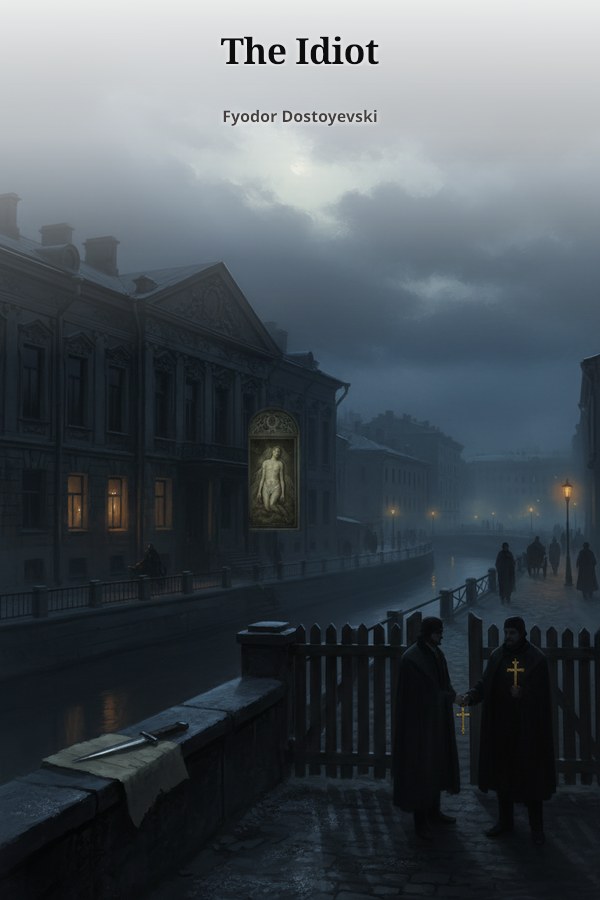
The Idiot is a word of Arabic origin most commonly used to describe those who are mentally deficient, foolish, or good-natured to the point of naivety. The word also lends its title to the famous work of Fyodor Mikhailovich Dostoevsky, one of the masterpieces of world literature.
The tragic dissonance that arises when Prince Myshkin, a completely honest, innocent, compassionate, and Christ-like 'good man,' enters the St. Petersburg society dominated by vanity, money, passion, and social hypocrisy. The destructive spiral created by Nastasya Filippovna, who is caught between two different types of love (Myshkin's pity-based Christian love and Rogozhin's possessive, passionate love), ends in catastrophe.
The Russian Empire; primarily the foggy, dismal city center of St. Petersburg and the greener, yet equally gossip-filled town of Pavlovsk, where the summer houses are located.
Mid-19th century (a period starting in November and extending to mid-summer).
Tense, gloomy, occasionally hysterical and crisis-ridden; an intense environment where sudden emotional swings, psychological breakdowns, and social corruption are intertwined. The inner conflicts of individuals reach an uncanny dimension in dark rooms and at midnight.
An observant third-person narrator who frequently enters the characters' inner worlds, occasionally interjecting with philosophical, social, or ironic commentary, and speaking directly to the reader.
Social status, money, titles, and marriage alliances are at the center of everything. Gossip, intrigue, and reputation largely determine people's fates. Purity, unconditional compassion, and honesty are labeled as a morbid 'idiocy' in this world and are generally mocked or exploited.
A Russia where class structures changed following the abolition of serfdom, where usury and bourgeois values collide with noble values; where enlightenment and nihilism clash with traditional Russian Christian values, and where even aristocrats have begun to act out of greed for money. A transitional period where young people are swayed by new and radical ideas and are experiencing crises of faith.
Characters are arranged at equal intervals on a circle; you can read the relationship type and dynamics by clicking on the lines.
Bir çizgiye tıklayarak ilişki detayını açın.
Myshkin approaches her with unconditional pity and compassion, wanting to save and respect her. Although Nastasya appreciates the Prince's innocence, she believes that her own perceived 'defilement' would ruin the Prince, so she constantly runs from him and chooses her own destruction.
Nastasya leaving the Prince to run away with Rogozhin, saying, 'I cannot ruin an angel like you.'
They become blood brothers by exchanging crosses, yet they are in a constant life-or-death struggle due to the opposing types of love they harbor for Nastasya Filippovna (pity vs. passionate obsession). Rogozhin both hates and deeply respects the Prince's moral superiority.
Rogozhin attempting to stab the Prince in a dark hotel corridor, only to flee in terror when the Prince suffers an epileptic seizure.
Aglaya loves the Prince's purity and honesty, idealizing him as the 'Poor Knight.' However, the Prince's social ineptitude and the unrequited pity he feels for Nastasya infuriate Aglaya, leading to a constant lack of communication and bitterness between them.
Aglaya giving the Prince secret letters to meet her in the park, only to mock him when they meet.
A dark and morbid attraction based entirely on the mutual destruction of both parties. Nastasya goes to Rogozhin as if to punish herself so as not to defile the Prince, but she knows Rogozhin will kill her and lives in fear of him. Rogozhin sacrifices everything to possess her, but he is aware that Nastasya inwardly looks down on him.
Nastasya abandoning the Prince just before their wedding, running into Rogozhin's carriage in the crowd, and shouting, 'Take me away from here!'
Ganya is disturbed by the Prince's insights and purity because the Prince can easily see through his ambitions and weaknesses. Ganya first tries to use the Prince, thinking he is an idiot, but later comes to hate him out of the shame created by his own vanity.
Ganya, in a fit of nervous collapse, striking the Prince across the face with a violent slap, and the Prince responding to him calmly.
Ganya wishes to marry Nastasya solely for the 75,000-ruble dowry. Nastasya finds this greed and weakness of Ganya's spirit repulsive; she tests him and humiliates him in front of everyone.
Nastasya testing his honor by throwing 100,000 rubles into the fireplace and telling Ganya, 'If you take the money out without burning your hands, it is yours.'
Both women love the Prince but cannot share his affection. Nastasya writes insistent letters to Aglaya for her to marry the Prince in order to demonstrate her superiority and renunciation. Aglaya, disgusted by Nastasya's arrogant 'fallen woman' persona, attacks her.
Aglaya going to Nastasya's house and calling her an 'insolent, fallen woman,' and Nastasya taking the Prince from Aglaya's hands for revenge.
Lizaveta sees the Prince's pure heart and, finding her own honesty in him, takes him under her wing as if he were her own son. However, the Prince's social gaffes and his relationships with 'fallen' people constantly anger her.
After the party where the Prince breaks the vase, Lizaveta trying to defend him while feeling both pity and anger toward him.
The dying Ippolit harbors deep resentment and jealousy toward the Prince's health, virtue, and spiritual tranquility. The Prince, conversely, feels pity for Ippolit's suffering and struggles.
Ippolit attempting a failed suicide after reading his long and rebellious philosophical confession in front of all the guests, and blaming the Prince for his own shame.
Lebedev exploits the Prince's innocence for his own financial or scheming interests, yet he is also a tragicomic figure who tries to seek forgiveness in the face of the Prince's spiritual greatness. The Prince knows of his hypocrisy but forgives him regardless.
Lebedev secretly meddling with Aglaya's letter and trying to keep the Prince under his control inside his own house.
Ganya is interested in Aglaya due to her prestige and his own ambitions, and he strives to stay in contact with her. Aglaya, however, sees Ganya's weaknesses clearly; she uses him merely as a messenger or a tool to provoke the Prince, and holds him in contempt.
Aglaya receiving the secret note brought by Ganya with indifference and later using it as a plaything to provoke the Prince.