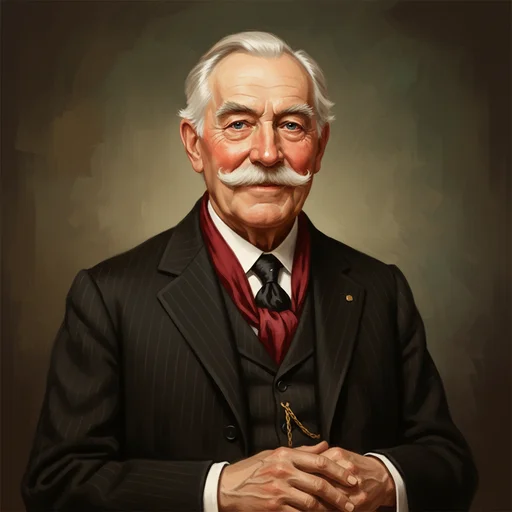


Napoleon Hill
Think and Grow Rich, authored by Napoleon Hill and published in 1937, is a personal development classic that describes methods for achieving financial and personal success through mental transformation. The work emphasizes the role of the power of thought, focusing on goals, and persistence in creating wealth.
The struggle to sustain a burning desire and faith against internal limits and fears (fear of poverty, criticism, and ill health) in order to achieve one's goals.
United States; primarily business, industry, and manufacturing centers (New York, Chicago, Detroit, New Jersey, Pennsylvania).
Early 20th century and its first half (specifically the 1900s and 1930s, after the Great Depression context).
Motivational, inspirational, philosophical, realistic, actionable, and full of hope. A spiritual and self-help-oriented environment blended with a scientific tone.
First-person (Author Napoleon Hill). Uses an advisory, persuasive, and philosophical tone that addresses the reader directly.
Thoughts are things; the human mind can achieve whatever it can believe and conceive. Nothing in the universe is obtained for free; a price must be paid for what is desired. Temporary defeats are not permanent failures; those who do not quit will eventually win. The only real limit upon a person is the one they set within their own mind.
The era of capitalist progress following the American Industrial Revolution. A period marked by the rise of self-made billionaires (Carnegie, Ford, Edison) and the vast opportunities brought by the free market.
Characters are arranged at equal intervals on a circle; you can read the relationship type and dynamics by clicking on the lines.
Bir çizgiye tıklayarak ilişki detayını açın.
Carnegie is the main catalyst who expands Hill's vision. Without providing financial support, he tasks Hill with a challenging research project on the philosophy of success that will last over 20 years. By accepting this task, Hill becomes the vehicle to spread Carnegie's invisible 'secret' to the masses.
Carnegie carelessly tossing his secret to me while I was still a young man and carefully observing my reaction.
Although Barnes initially appears like a penniless hobo, he is filled with the desire to become Edison's partner. Edison senses this burning desire and determination in Barnes and gives him a chance, even though it is in a menial position; eventually, Barnes becomes Edison's partner by selling the Ediphone.
Edison remarked about him, 'He stood there like an ordinary tramp, but the expression on his face told me that he was determined to get what he had come for.'
Schwab convinces financial giant Morgan with a cleverly prepared, highly persuasive vision presentation. This strategic communication between the two results in the birth of the greatest steel monopoly in American history (U.S. Steel).
After Schwab's extraordinarily persuasive speech that hypnotized eighty millionaires, Morgan made the decision to back him and purchase Carnegie's interest.
Schwab is the loyal and brilliant manager who maximizes Carnegie's operations. While looking out for Carnegie's interests, he practices subtle diplomacy to convince him to sell his massive steel company to Morgan.
On the golf course, Schwab managed to lift Carnegie's spirits and convince him to sell his company for $400 million.
They were partners in mining. They set out with the desire to find gold but gave up in despair just one meter before reaching their goal. Their shared goal ended in failure, and while the uncle faded away, Darby learned a lesson from it.
Uncle and Darby continued digging to find gold, but when the venture turned up empty, they sold the machinery to a junkman and gave up.
It is a struggle between physical force and unwavering determination. While the uncle is an angry, rude, and physically strong man, the little girl tames his rage with absolute resolve and fearlessness, securing the 50 cents she wants.
Despite the uncle approaching her with a stick in his hand, the girl did not back down and compelled him to submit by saying, 'My mother needs fifty cents!'
While engineers think within the limits of their technical training and say 'impossible,' Ford focuses solely on his vision and belief. In the interaction, the vision constantly prevails; Ford's unwavering will conquers the limitations of the engineers' knowledge.
Even though the engineers said it was impossible to put an eight-cylinder engine into a single block, Ford imposed his will by saying, 'Keep going until you succeed.'
They are united by determination against fear and death. By establishing a strong network of ideological solidarity among themselves (the Committee of Correspondence) with the goal of political freedom, they eventually paved the way to the Declaration of Independence.
Names like Adams, Hancock, and Lee formed a 'Mastermind' group among themselves through correspondence and organized all the colonies.
The father rejects the fact that his son is deaf and mute and implants his own unwavering belief into the child's subconscious. With this secret and ongoing support from his father, Blair acquires the desire to turn his disability into an advantage.
Hill tried to convince his son that being born deaf was not a disadvantage but a great blessing that could bring money and success, and he succeeded.
Gunsaulus, who preaches his desires with definite plans to an audience he does not know, attracts Armour's attention. A determined desire attracts its source to itself, even if it is not clear where the necessary money will come from.
Impressed by Gunsaulus's speech, Armour called him to his office and immediately gave him one million dollars to establish an educational institution.