
Jane Austen
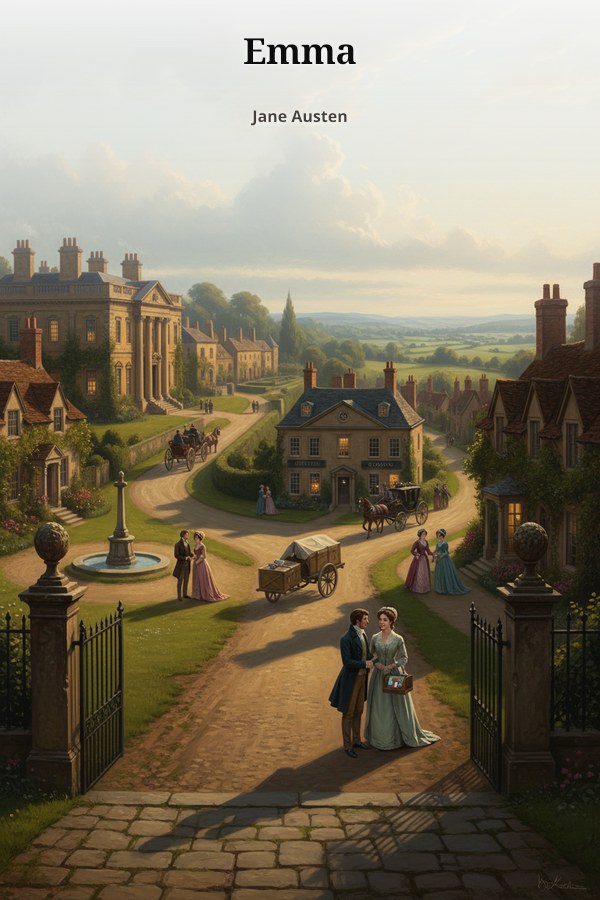
Jane Austen's "Emma," published in 1815 and her personal favorite novel, is a classic work of satire set in rural England. It follows the wealthy, clever, and match-making-obsessed Emma Woodhouse as she navigates her own love life and the erroneous influence she exerts on those around her. While interfering in the lives of others, the character discovers her own path to maturity and true love, thanks to Mr. Knightley.
Emma’s manipulation of the lives of those around her (especially Harriet) due to her excessive belief in her own intelligence and ability to influence others, and her painful discovery at the end of these arrogant games of how estranged she actually is from her own true feelings.
Highbury, a rural and affluent provincial town in England, along with the surrounding Hartfield Estate, Randalls, and Donwell Abbey.
Early 19th century (Regency England)
The atmosphere of a cheerful, gossiping, and insular country town; a seemingly serene environment where class distinctions are clearly drawn, yet every moment of life is governed by rules of politeness and etiquette, while beneath the surface, it is filled with gossip and intrigue.
Omniscient third-person, generally reflecting events through Emma's perspective, capturing her blind spots and delusions in a tone that is gently ironic, critical, yet affectionate.
Social life is divided by strict class boundaries; there are clear lines between gentlemen, merchants, and farmers. The only way for women to attain a respectable status is to make a good marriage. Women of good breeding who fall into poverty have no choice but to become governesses. Moral integrity is equated with outward etiquette, and any inappropriate behavior immediately leads to a scandal within the closed town.
The relations between landed gentry in the countryside and the gradually prospering middle class; the classic English provincial hierarchy where respectability is equated with wealth, lineage, and manners.
Characters are arranged at equal intervals on a circle; you can read the relationship type and dynamics by clicking on the lines.
Bir çizgiye tıklayarak ilişki detayını açın.
For most of the novel, Knightley serves as an authority and older-brother figure who does not hesitate to confront Emma with her mistakes and educate her. Although Emma occasionally opposes his criticisms, she deeply values his approval. The thought that Harriet might have feelings for Knightley brings Emma's suppressed love to the surface, and the relationship evolves into an equal romantic partnership.
Knightley's words, 'I will tell you truths while I can. I am proved to be your friend,' and the fact that Emma values his opinion above all others.
Emma sees the innocent and impressionable Harriet as a social project, controlling her by pushing her away from her own class and toward high ideals (!). Although Harriet is initially dependent on Emma with adoration, she eventually gains the courage to make her own decisions; the friendship fades and gives way to a more appropriate distance.
Emma having to restrain Harriet regarding love by saying, 'I warn you... I am not promising that you will be successful.'
The power balance between them involves a constant, abrasive tension due to their secrecy. Frank's cunning flirtations in Highbury to distract others take a toll on Jane. Jane's rigid moral stance and Frank's carefree, flighty demeanor clash, but their deep love eventually overcomes obstacles.
The admission in Frank's letter: 'I suppose the secret engagement must have been much harder and more dangerous for the girl than for Frank Churchill.'
While Emma sees Mr. Elton as a suitable object to be reserved for Harriet, the arrogant Mr. Elton rejects Harriet, who is below him in class, and pursues the wealthy Emma directly. His rejection causes him to hold a grudge against Emma.
Mr. Elton protesting to Emma: 'Who could think of Miss Smith when Miss Woodhouse is near? No, upon my honor, there is no duplicity in this matter.'
Harriet essentially has sympathy and respect for Martin, but she rejects him due to Emma's strong interference. Martin's perseverance and unwavering good intentions eventually draw Harriet back to the realistic ground where she belongs.
Harriet feeling genuine happiness upon receiving Mr. Martin's letter, saying, 'I never thought he could love me this much.'
As Emma sees her own shortcomings (especially in her perseverance with the piano and art) and Jane's overwhelming talents, she chooses to distance herself from Jane and secretly generates groundless slanders against her. Later, when she understands the hardships Jane has endured, the situation turns into deep respect.
Emma feeling great remorse as she says to herself, 'If the balance of good and evil done by me to Jane Fairfax could be struck...'
A fake but flamboyant courtship begins between two characters who enjoy each other's wit. While Frank uses Emma as a front, Emma mistakes his attention for love and has her ego stroked. When the truth is revealed, there is a sense of mutual relief rather than anger.
Emma explaining her feelings by saying to herself, 'I was captivated by the attention he showed, and I pretended to be very pleased by it... His aim was to pull the wool over everyone's eyes.'
Mrs. Elton, who is vulgar and nouveau riche, views taking the elegant Jane under her wing as a gateway to social prestige. Jane tolerates her out of desperation, while Mrs. Elton arrogantly believes she is managing Jane's life.
The frustrating possessiveness of Mrs. Elton, which Emma thinks of as: 'This girl is a riddle... choose to be buried by Mrs. Elton's intimacy, choose the poverty of Mrs. Elton's conversation! A real riddle!'