
İvan Gonçarov
Ivan Goncharov's famous novel, Oblomov, tells the story of the nobleman Ilya Ilyich Oblomov, who suffers from the disease of laziness, lack of willpower, and constant procrastination (Oblomovism). Unable to adapt to social change, refusing to get out of bed, and remaining indifferent to life, the character is the most prominent example of the "superfluous man" type, symbolizing dysfunctional aristocracy and inertia in 19th-century Russia.
The tragic struggle between the desire within Oblomov to live, love, and be useful, and the 'Oblomovism' (fear of taking action, dependency on a comfort zone, utter inability in administrative and practical matters) ingrained in his soul since childhood. The manifested conflict between mental desire and volitional paralysis.
The city of St. Petersburg (Gorokhovaya Street, the summer district, Vyborg Side) and the distant, utopian estate of Oblomovka, which exists only in childhood memories and dreams.
Mid-19th century (1840s-1850s). A transitional period in Tsarist Russia, just before the abolition of serfdom and the great reforms.
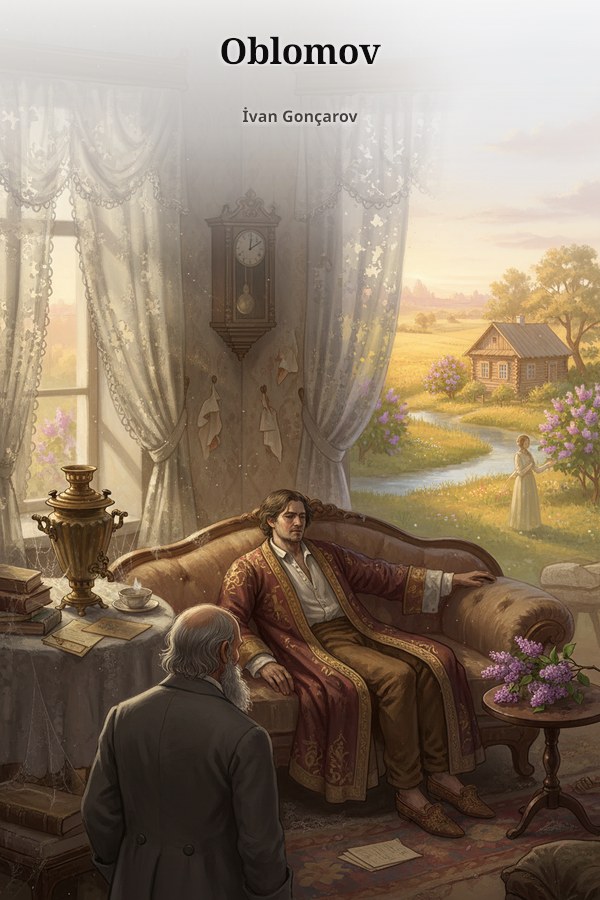
A stuffy, dusty, sedative, and somber stillness behind closed doors, contrasted with the noisy and hectic city life outside (Saint Petersburg), yet occasionally fairytale-like and melancholic. The sunny, carefree, and soft atmosphere of Oblomovka, which lives on in dreams, wrapped in maternal tenderness.
Omniscient third-person. The narrator sometimes focuses on the characters' inner worlds, pasts, and dreams with a very close, detailed, and ironic language, yet adopts a fatherly tone that strives more to understand them and explain them to the reader than to judge them.
People either lead an existence based on the rules of the old world—lethargic, comfortable, satisfied with what they inherited, and resistant to change—or they adapt to the rules of the new world: the necessity of constant work, reading, learning, and chasing goals. People of the old system (Oblomovism) are unable to tolerate the slightest imposition of the outside world (work, paperwork, moving, confrontation) and succumb to mental and physical illnesses.
The gradual loss of function of the old landed gentry (feudal lords) in Russian society, who deemed working and earning money beneath their noble status. In contrast, the emergence of a new class of intellectuals/businesspeople (Stolz) who were educated in Europe and possessed practical, rational, and bourgeois qualities.
Characters are arranged at equal intervals on a circle; you can read the relationship type and dynamics by clicking on the lines.
Bir çizgiye tıklayarak ilişki detayını açın.
Two school friends, one representing total stagnation and the other constant movement. Stolz pushes Oblomov like a parent to get him moving and into the outside world; Oblomov views Stolz's endless energy with a feeling between admiration and exhaustion. While Stolz values Oblomov's innocence and pure heart, Oblomov sees Stolz as a lifesaver for his strong will.
Stolz forcing Oblomov to go on a trip to Europe and change his life by saying, "Now or never!"
Olga aims to recreate Oblomov by pulling him out of the swamp of laziness (the reverse of Pygmalion and Galatea) and falls in love with this process. Oblomov, meanwhile, sees Olga as an ideal, an angel, and wakes up by her side, but feels inadequate and fearful in the face of her constantly demanding energy that forces growth. Initial excitement eventually gives way to collapse in the face of the reality that Oblomov cannot meet life's standards.
Oblomov writing the long letter stating his intention to break up and Olga crying, as both feel the incompatibility in their expectations.
They are like the last representatives of the old order. They cannot function without each other, yet they argue constantly. Zakhar is irreverent enough to curse his master but loyal enough to give his life for him; Oblomov is dependent on Zakhar because he cannot even put on his own socks.
Zakhar grumbling as he climbs down from the stove every time Oblomov calls "Zakhar!", and Oblomov blaming him for his own lethargy.
Oblomov escapes the stressful 'ideal' life with Olga and takes refuge in a house offered by Agafya, where she demands nothing, does not criticize, and only provides for his comfort. Agafya loves Oblomov like a saint, silently fulfills his every need, and a routine is established between the two based not on logic, but purely on physical and daily comfort.
Agafya secretly pawning her own pearls and dresses to cover kitchen expenses so that Oblomov's comfort is not disturbed.
After the painful experience Olga had with Oblomov, Stolz becomes her true guide on the path to understanding the world and setting goals. Their relationship begins within the framework of reason and respect, later evolving into a deep, solid, and egalitarian marriage. Stolz nurtures Olga's bottomless intellectual curiosity.
The parts in Switzerland, by the river or mountainside, where Stolz explains the purpose of life to Olga and Olga shows her devotion by believing in him.
Tarantyev possesses a coarse, boisterous, and swindling nature; he takes advantage of Oblomov's helplessness to sponge off his money, clothes, and food. Oblomov, avoiding arguments and confrontations, turns a blind eye to this situation.
Tarantyev forcibly taking Oblomov's silk suits for himself and imposing harsh conditions on the contract while leasing the house on his behalf.
While Zakhar is lazy, clumsy, and slovenly, Anisya is industrious, skillful, and clever. Anisya quickly takes control of the kitchen and housework; although Zakhar initially grumbles and tries to assert his authority over his wife, he is forced to accept Anisya's superiority and her management of the household.
When Zakhar is about to break the glasses, Anisya skillfully takes the tray from his hands and puts everything in its place, and Zakhar realizes she is smarter than he is.
Ivan Matveyevich ruthlessly exploits his sister Agafya's naivety and ignorance for his own financial gain. Since Agafya is structured to submit unquestioningly to male authority, she does not realize that the blank papers her brother has her sign are intended to frame Oblomov (a fraudulent promissory note).
Ivan Matveyevich having his sister sign a document full of long, legalistic words without reading it, under the guise of 'necessary household expenses.'
Both are cunning urban types who unite to profit from Oblomov's lethargy and naivety. They come together to plot with fake rental contracts and fake promissory notes, greedily discussing over drinks how they will fleece their prey.
Conspiring in a tavern on how to extract thousands of rubles from Oblomov under the cover of legal procedures.
Alexeyev is a nondescript man with no distinct face, voice, or presence, who never gets involved in anything. Oblomov keeps him in his room only to provide company and to act as a docile object he can talk to whenever he feels like it.
Alexeyev sitting in front of Oblomov's bed for hours, saying 'yes' to everything without even defending his own opinion, serving merely as background.