
Charles Dickens
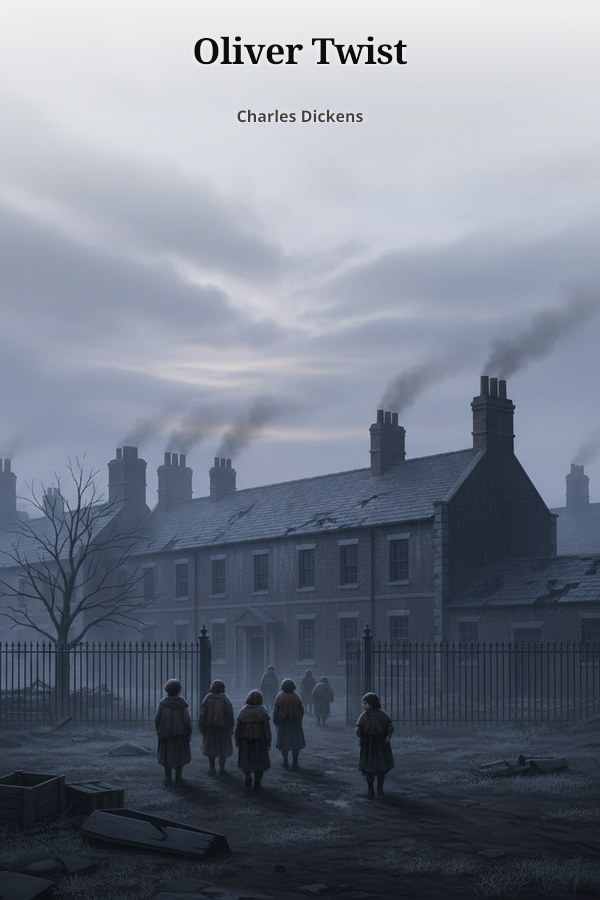
Oliver Twist, written by Charles Dickens, is a classic novel that tells the story of an orphan struggling to survive within the world of poverty, injustice, and crime in 19th-century England. It follows the journey of a pure and kind-hearted character as he tries to escape from underground criminal gangs and find his true family.
It is the struggle of Oliver, an orphan who is pure and well-intentioned by nature, to protect his soul, body, and innocence against the efforts of the ruthless adults and the dark criminal underworld surrounding him that seek to drag him down to their level and corrupt him.
England; the gloomy workhouse in the countryside, Sowerberry's old funeral parlor, the dangerous and dirty backstreets of London, Fagin's secret hideouts, and the peaceful, pristine homes of Mr. Brownlow and the Maylie family.
Mid-19th Century (Victorian England)
The story, beginning in an environment of oppressive, hopeless, and dark misery, presents the cold reality of poverty, hunger, and theft to the reader. However, as events unfold, this dark atmosphere evolves into a more hopeful and bright structure where compassion, family warmth, and divine justice manifest.
Omniscient third-person narrator. While frequently conveying events to the reader in a bitter tone containing irony and social criticism, the narrator reflects deep compassion and pity for innocent characters, especially Oliver.
A ruthless system functions according to Victorian values. Orphans and the poor are worked like slaves, half-starved in workhouses. The criminal underworld is a place with its own rules, where lies and betrayal are taken as the norm. In contrast to this, well-intentioned bourgeois (such as Mr. Brownlow) benevolently help innocent poor people.
Following the Industrial Revolution, the Workhouse system established by the state, along with increasing misery, is criticized. Under the guise of disciplining the poor, the system abandons them to hunger, which pushes children into the arms of street criminal networks (pickpocket gangs).
Characters are arranged at equal intervals on a circle; you can read the relationship type and dynamics by clicking on the lines.
Bir çizgiye tıklayarak ilişki detayını açın.
Fagin attempts to make Oliver a thief for his own interests while remaining ostensibly affectionate. Oliver is both deathly afraid of him and, due to his initial innocence, cannot fully understand his games.
Fagin tries to break the boy's moral foundation by keeping Oliver locked up for days and telling him terrible theft stories filled with lies.
Mr. Brownlow is a symbol of absolute goodness who pities Oliver, rescues him from the criminal world, and provides him with food, security, and education. Oliver feels infinite gratitude and a love so great that he could never disobey him.
Mr. Brownlow takes pity on the boy who is thought to have stolen money from his pocket, puts him to bed, and begins to raise him like his own child.
Nancy is bound to Sikes with deep desperation; Sikes is a cruel and brutal partner who sees her only as a tool. The power balance between them is established entirely through Sikes's physical and psychological violence.
When Sikes learns that Nancy spoke to Mr. Brownlow, he ruthlessly kills her without hesitation by striking her with the butt of his pistol.
Both are criminals who suspect each other but need one another for dirty business. While Fagin operates with deceit and intellect, Sikes represents brute force and violence.
As Fagin and Sikes secretly plan the house they will loot and put the children in danger, only a cold and threatening relationship based on money is visible between them.
Nancy is initially the person who forcibly brings Oliver back to the criminal gang, but she sees the child's innocence as her own lost childhood, experiences an awakening in her soul, and decides to save him at any cost.
Nancy risks her life to go secretly to Mr. Brownlow and ensures the boy's salvation by revealing the gang's dirty scheme involving Oliver.
Bumble uses his authority over the poor like a psychological and physical sword. For Oliver, he is the embodiment of the nightmare and fear in the workhouse.
Because Oliver asked for a little more gruel, Mr. Bumble views this as a massive crime, imprisons him in a dark room for days, and rents him out to the undertaker.
Monks wants to destroy his brother Oliver's reputation and have him imprisoned to seize the inheritance; Oliver is initially completely unaware of who this dark figure is and the blood tie between them.
Monks buys the locket that provides proof of Oliver's past and throws it into the river just so the truth is not heard.
At the funeral parlor, Noah attempts to alleviate his own feelings of oppression and complexes by belittling Oliver, who is younger and more helpless than him. However, when the line is crossed, the weak Oliver rebels.
When Noah insults Oliver's late mother by calling her a bad woman, Oliver grabs Noah by the throat with incredible strength and tackles him to the ground.
While Grimwig is a pessimistic, skeptical character with little faith in human nature, Brownlow is optimistic and trusting. The friction between them is always in the form of a good-natured yet sharp rivalry.
When Oliver sets out to deliver the books, Grimwig claims the boy will run off with the money and never return, asserting that if he does return, he will cut off his own hands.
Jack, with his confident and relaxed demeanor, acts as a guardian of sorts to the weary Oliver; he feeds him and, by promising him shelter, leads him straight into the wolf's den, to Fagin.
Jack finds the hungry Oliver on his way to London, feeds him bread, and hands him over to Fagin by telling him of 'a famous gentleman who will give you free lodging.'