

Alexandre Dumas
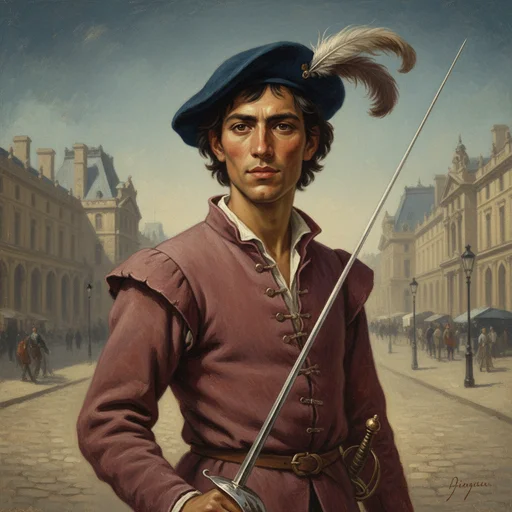
The Three Musketeers is a world-famous historical adventure novel written by Alexandre Dumas, detailing the adventures of d'Artagnan, a brave youth who arrives in 17th-century France with the desire to join the King's Guard. Upon arriving in Paris, d'Artagnan finds himself caught in the middle of royal intrigues, political conspiracies, and dangerous duels.
The attempt by D'Artagnan and his three loyal musketeer friends to travel to England to retrieve diamonds in order to protect the honor of Queen Anne of Austria and, consequently, the peace of France; contrasted with the deadly traps laid by Cardinal Richelieu to stop them at all costs for his own political and personal ambitions.
The dark streets of Paris, the Louvre Palace, Mösyö de Treville's mansion, the Bastille dungeons, and the travel routes stretching from France to England (Amiens, Calais).
Around the year 1625 (first half of the 17th century).
A chivalrous, tense, and daring atmosphere blended with the political intrigues, relentless dangers, battles of honor, and clash of swords in 17th-century France.
An omniscient third-person objective narrator with a wise, subtly ironic, and engaging tone who occasionally speaks directly to the reader.
Honor and integrity are held in higher regard than one's life or even their property. A dispute between noblemen and musketeers does not end without bloodshed or a decisive victory. The security of the kingdom is shaped by a secret power struggle between the King and the Cardinal. While musketeers are only accountable to their commander and the King, their duels with the Cardinal's guards are implicitly supported despite being illegal.
A repressive and hierarchical European context during the reign of King Louis XIII, where Cardinal Richelieu holds the reins of the state, and diplomatic tensions between England (Protestant) and France (Catholic) and Spain have reached a breaking point.
Characters are arranged at equal intervals on a circle; you can read the relationship type and dynamics by clicking on the lines.
Bir çizgiye tıklayarak ilişki detayını açın.
Their relationship, which began with a challenge, turned into great admiration and mutual sacrifice after fighting side by side. While Athos appreciates D'Artagnan's strategic mind, D'Artagnan respects Athos's noble and reserved manner, seeing him as a moral compass.
During the first major skirmish with the Cardinal's guards, D'Artagnan saves Athos's life while he is wounded, and later, as secret travel plans are made, Athos says, 'You are a brave man, I am ready to follow you,' and hands the initiative over to him.
Although D'Artagnan often teases Porthos playfully about his vanity and boastful nature, he relies heavily on his strength and companionship in battle. Porthos is sometimes surprised by the Gascon's wit and follows his lead.
During their first encounter at Monsieur de Tréville's mansion, D'Artagnan accidentally discovers that the back of Porthos's flashy shoulder belt is fake, embarrassing him and leading to a duel challenge.
D'Artagnan, who inadvertently reveals Aramis's secret affairs, initially earns his enmity; however, D'Artagnan's refinement and courage later endear him to the knightly heart hidden behind Aramis's clerical mask.
He has a tense confrontation with Aramis over a lady's handkerchief found on the ground, but after fighting the guards together, this rivalry turns into unshakable loyalty.
D'Artagnan falls deeply in love with her at first sight. Their relationship blossoms when D'Artagnan saves her. D'Artagnan enthusiastically takes on the mission of protecting her and the Queen she represents, risking his life.
When D'Artagnan agrees to go to London for the Queen, he turns to Madame Bonacieux and says something to the effect of, 'I love you; if I fulfill this order, my greatest reward will be to know that you harbor the same feelings for me.'
While the King is forced to bow to the Cardinal's intelligence and absolute capability, he is constantly bothered by his own authority being overshadowed. The Cardinal, meanwhile, pulls the strings of the state and treats the King only as a tool for his own ends.
When swords are drawn between the Cardinal's men and the King's musketeers, the King secretly takes great pleasure in his own musketeers defeating the Cardinal's, and awards D'Artagnan six hundred écus.
Buckingham has such an intense obsession with the Queen that he would drive all of France and England to war. The Queen, crushed between the weight of her position and her feelings for him, desperately tries both to turn him away and to prevent disasters.
During their secret meetings, as the Queen pleads for the Duke to return to London, she gifts him the diamond necklace in a rosewood box as a token of her heart and affection.
Being mocked and physically defeated during their first encounter leaves a lasting trauma for D'Artagnan. When Rochefort also steals his letter, this hostility turns into an absolute desire for revenge.
Whenever D'Artagnan sees this dark-haired man with the scar on the streets of Paris, he abruptly drops even his most vital tasks and begins to run after him like a madman, sword in hand.
Taking D'Artagnan, the son of an old friend, under his wing, Treville curbs the young man's impulsiveness and teaches him how to survive in the court and within military discipline.
He gives advice to D'Artagnan from the very first day, cautioning him to stay alert amidst the conflicts between the Cardinal and the King, and writes him a letter of recommendation to receive training at the academy.
There are chasms between them. While the woman is loyal, young, discreet, and capable of giving her life for the Queen, her husband is someone who thinks only of his own pocket, a coward who changes sides at the first sign of pressure.
Once Monsieur Bonacieux is bought off by the Cardinal and Rochefort, he immediately begins to accuse his wife and act as a spy for the Cardinal, whereas Madame Bonacieux accuses her husband of turning into a 'wretched and dim-witted' man.
Although Planchet is initially dissatisfied due to his master's lack of money, over time, D'Artagnan's courage, his resolve during difficult times, and his integrity lead Planchet to feel unconditional respect and devotion toward him.
After D'Artagnan gives him a sound thrashing, the promise that 'a bright future awaits you by my side' inspires respect in Planchet; during the London expedition, declaring 'I am a Picard,' he fearlessly attacks the enemies in front of his master.