

Ethica — 6 karakter
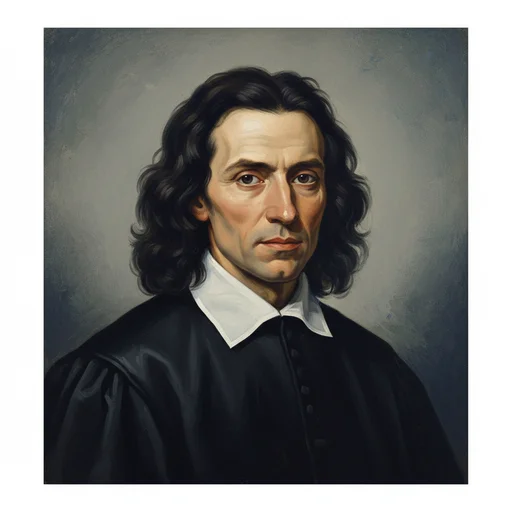
Baruch Spinoza
He was born in Amsterdam on 24 November 1632. His family were Portuguese Jews who had fled the Inquisition and taken refuge in the Netherlands; his father, Michael, was a merchant. His mother, Hanna Debora, died before he turned six. At the congregation's Talmud Torah school he studied Hebrew and the religious texts, and as a boy he worked in his father's trading house. After his father's death in 1654 he gave up commerce; at the Latin school of Franciscus van den Enden, a former Jesuit, he came to know Descartes, the new natural science and the dissenting circles of Amsterdam. His views unsettled the congregation: on 27 July 1656, aged only twenty-three, he was cast out with the harshest ban the Portuguese community of Amsterdam had ever pronounced. He took the name Benedictus; the Principles of Descartes' Philosophy, published in 1663, remained the only book to appear in his lifetime under his own name. He settled in Rijnsburg near Leiden, then in Voorburg, and finally in The Hague. He earned his living grinding lenses for microscopes and telescopes, and corresponded about that craft with the opticians of the day, Christiaan Huygens among them. In 1670 he published the Theological-Political Treatise without his name on it; the book was banned in 1674. In 1673 he declined the chair offered him from Heidelberg, on the grounds that it would restrict his freedom of thought. He built the Ethics out of definitions, axioms and propositions, in the order of a book of geometry, and treated the passions not with moral reproach but with the composure granted to natural events. He never risked publishing it while he lived. He died in The Hague on 21 February 1677, at forty-four, of a lung disease aggravated by years of breathing glass dust. His friends printed his manuscripts in secret that same year; his books reached readers only after he was gone.
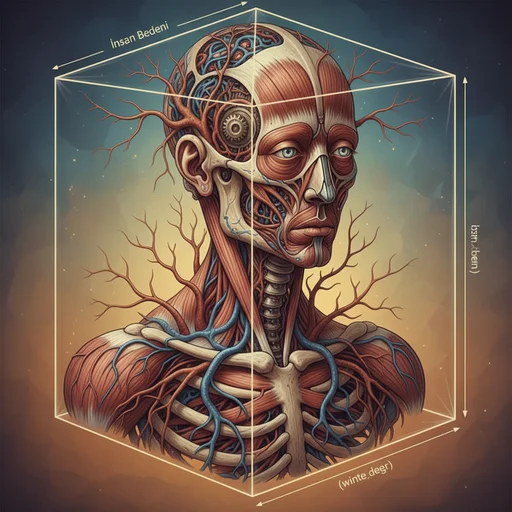
Human Body (Attribute of Extension)
The Human Body is a finite mode and form of the 'Extension' (physical volume, weight, occupying material space) attribute of God or Nature's eternal substance. It is a massive organizational unit composed of an infinite number of smaller particles, liquid, hard, and soft parts, possessing a mechanism of motion and rest. In order to sustain its life and form (conatus), it is constantly dependent on other bodies in its environment, external objects, and the sustenance and air of nature. As it makes contact with other bodies, it is shaped, worn down, sickened, or enlivened by the impacts they impart. It is the biological headquarters that continuously provides data flow to the Human Mind and can push it into the darkness of passive affects or transport it to active experiences.
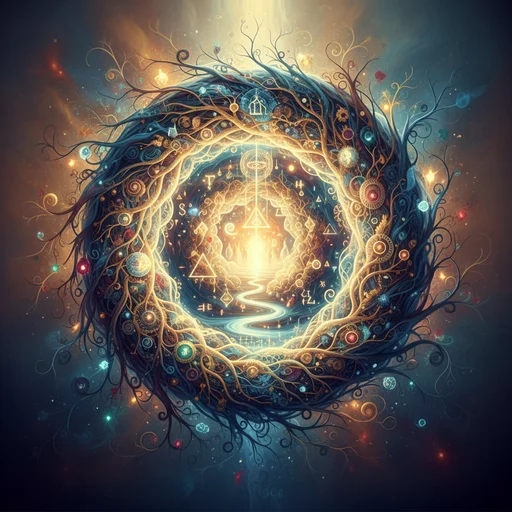
The Human Mind (Attribute of Thought)
The Human Mind is merely a fragmentary manifestation of God's infinite and eternal intellect under the attribute of Thought (Cogitatio) and is the mirror of the human body. It is not an independent soul floating in the air on its own; it is like a central software that simultaneously perceives the body's affects, desires, and changes, and generates ideas accordingly. Because it feels itself and the body only through affects, it is quite prone to incomplete knowledge (fancies, illusions) from the very beginning. However, it also possesses a very valuable tool that can overcome this passivity: using adequate ideas—that is, reason—to transform sensations into clear, causal concepts, which means 'knowing the truth'.
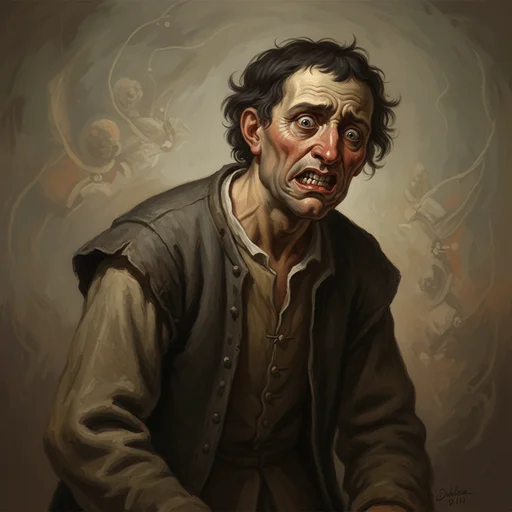
The Enslaved Human / The Ignorant Human
The Slaved Human represents the masses who, deprived of the light of reason, have completely surrendered the control of their existence to external world perceptions and fleeting, distorted emotions. This is precisely the tragedy at the core of the work: while the human being desires to exist and preserve themselves, they drown in the process among sycophants, tyrants, superstitions, or excessive passions that end in sorrow. Even if they grasp the good, they suffer for succumbing to evil. They feel an endless fear of death and shape all their actions with merchant-like beliefs, such as avoiding burning in eternal fire or extracting favor from God. By assuming their delusions, jealousy, and anger to be the world's greatest truths, they voluntarily imprison themselves in the darkest dungeons of ignorance. They do not hesitate to drag social life into chaos for the sake of their momentary interests and delusions.
Free Man (Person of Reason)
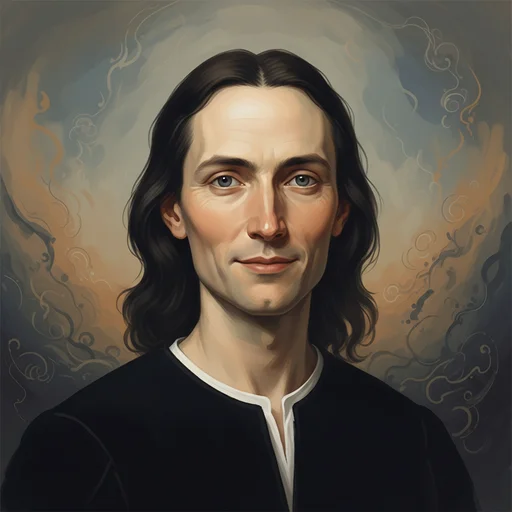
The figure of the Free Man is a conceptual character in philosophical literature who describes the state of a human being who has completed their evolution and liberated themselves from the slavery of nature through reason. It symbolizes the wise person. The free person structures their life not according to emotional fluctuations or the temporary devastations that the external world may bring, but according to the third kind of knowledge, which is an intellectual tranquility. They never allow their own desires to conflict with superior natural laws; therefore, instead of feeling pride, envy, or misplaced pity toward others, they seek to meet them at the level of understanding and reason. Their greatest virtue is the knowledge of God. They cling to life not with resentment or tears, but with the foundation of a constant and unshakable joy that maximizes their power to act. They are, in a way, like the formulated ideal statue of Spinoza’s own life.
God / Nature (Deus sive Natura)
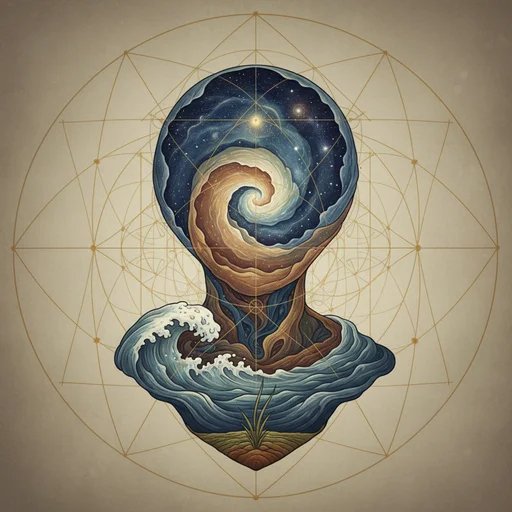
God or Nature is the single and absolute Substance upon which Spinoza's ethics is built. It is absolutely not the anthropomorphic creator mechanism described by traditional religions that gets angry, shows mercy, or possesses a will. Everything that exists consists of Him; He and only He is the cause of His own existence (Causa Sui). He has infinite attributes, the primary ones being Extension and Thought, and infinite manifestations of His attributes. Every event, object, and thought in the world and in our minds is a mode erupting from these infinite attributes of His. In Him, everything operates with infinite necessity; luck, purpose, or supernatural coincidences cannot exist in His order. That He is free is only due to the fact that He compels Himself according to the laws of His own nature. Within the circle of the Ethics, God is the purest rational perception, and the pleasure derived from Him is the most powerful emotion that leads humanity to lasting wisdom and enlightenment.