
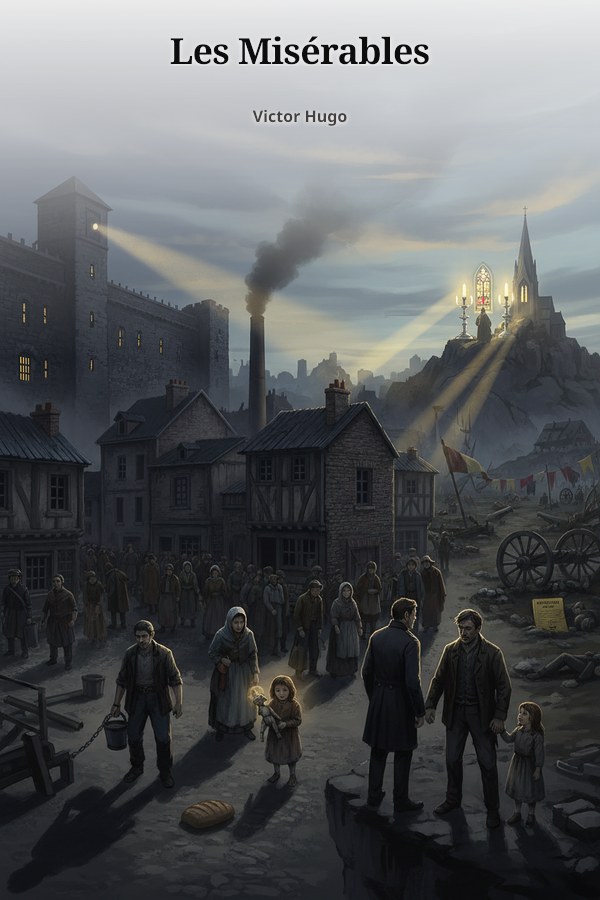
Victor Hugo
Victor Hugo's famous work Les Misérables, published in 1862, is a massive historical novel set in 19th-century France that explores themes of poverty, justice, conscience, and redemption. It critiques social injustices through the struggles of Jean Valjean, who served 19 years of hard labor for stealing a loaf of bread, as he attempts to reintegrate into society while being pursued by Inspector Javert.
The continuous cat-and-mouse game between Jean Valjean (Mayor Madeleine), an ex-convict whose life was ruined and who was ostracized by society for stealing a loaf of bread in the past, and the rigid, merciless representative of the law, Javert, who pursues him relentlessly as he tries to turn honest and spread kindness. The internal conflict Valjean experiences between turning a blind eye to the conviction of an innocent person for his own peace of mind, or sacrificing his life to achieve moral redemption.
France; the mountainous city of Digne where the Bishop resides, Montreuil-sur-Mer where Monsieur Madeleine becomes prosperous, the forests of Montfermeil—a place of poverty and exploitation, the Arras Assizes Court, the Toulon Prison, and the battlefield of Waterloo.
Early 19th century (the period spanning from 1815 to 1823, including the legendary Battle of Waterloo in 1815).
A melancholic, epic, and historical atmosphere in a dark, suffocating, corrupt, and unjust world, where rays of hope, spiritual salvation, and mercy emerge.
An omniscient third-person narrator who follows events from a divine perspective, provides lengthy analyses on society, philosophy, religion, and history, considers it their right to intervene in the story, and speaks directly to the reader.
Society's rules of crime and justice are unyielding and ruthless; the system does not care about how people are driven to error or their regrets. Instead of saving the individual it once branded, the law pushes them into a deeper darkness. However, in this world where social classes and state regulations bring collapse, true salvation is possible only through the divine-level compassion, sacrifice, and conscience that individuals show toward one another.
A chaotic transitional period characterized by the aftermath of the French Revolution, the Napoleonic Wars, and the struggle between revolutionary thought and the monarchical Restoration regime (under Louis XVIII). An environment where the poor and working class are crushed by severe economic crises, and where religious and class taboos dominate and women are despised.
Characters are arranged at equal intervals on a circle; you can read the relationship type and dynamics by clicking on the lines.
Bir çizgiye tıklayarak ilişki detayını açın.
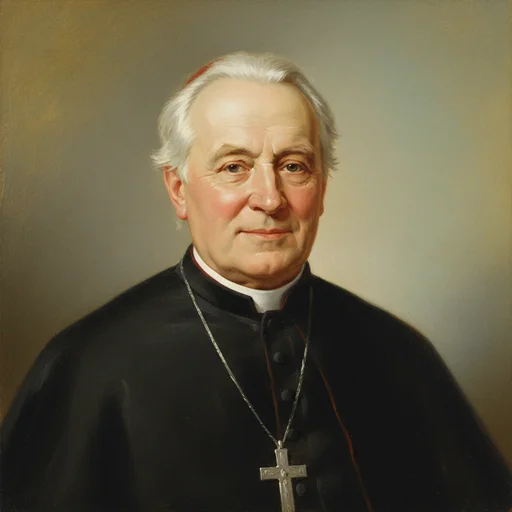
The Bishop accepts Valjean with unconditional love, without question, despite the hatred of all of society. His kindness, shown without expectation of return, tears out the hatred Valjean feels toward his own self and charts a divine course for his life.
The Bishop saving him from the gendarmes and saying, 'With these silvers, I have bought your soul and dedicated it to good.'
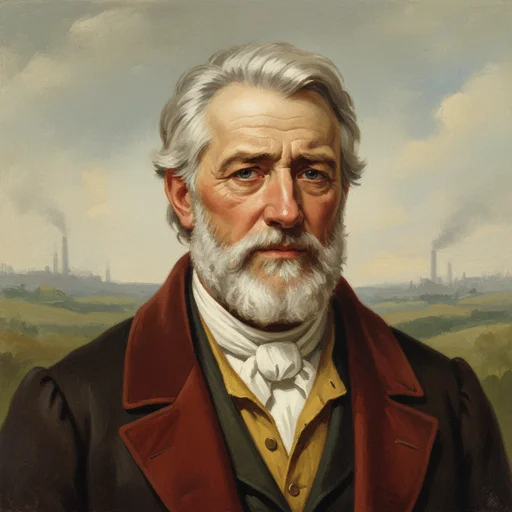
Javert is the tireless, loyal servant of law and blind discipline; Valjean is the representative of mercy and spiritual renewal. Javert refuses to believe in Valjean's virtues and constantly drives him to the edge of the abyss.
Javert coming to the mayoralty and saying he reported to Paris that Madeleine was an old convict and refusing to bow down to him.
A pure and unconditional bond. Fantine blindly sacrifices her own purity, health, body, and life in order to support her daughter, even from afar, and to keep her warm in the freezing winter.
Fantine selling her hair, her teeth, and her body in sequence to buy Cosette stockings, a toy, and skirts to keep her warm.
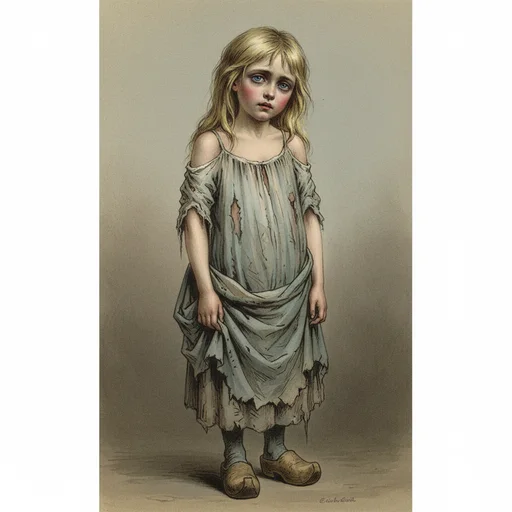
Madame Thénardier sees Cosette as an object, a slave; she denies her all the privileges she offers her own daughters and subjects her to violence. Cosette submits, always trying to avoid her master with deep obedience and silent fear.
The innkeeper forcing Cosette to draw water in the forest in the freezing cold and pitch-black midnight by scaring and pushing her.
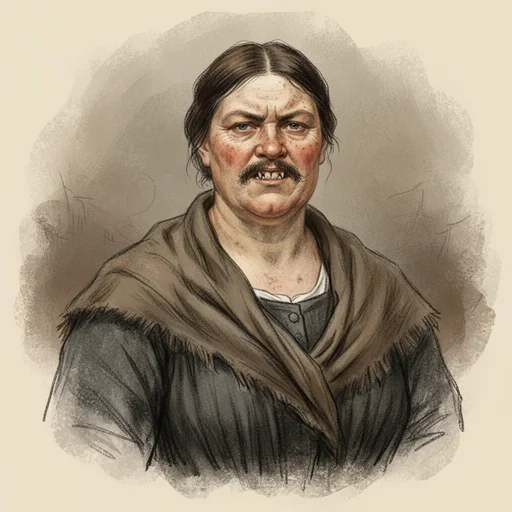
While the Madame is the brute force that puts cruelty and hatred into action, her husband Monsieur Thénardier represents the mind that devises cunning schemes and extorts customers. Even though the woman is burly and angry, she goes silent before her husband's deceitful authority.
While the Madame cannot stomach Cosette being made happy by the rich stranger with a doll, the husband calms her by saying, 'This is just for money, the man is paying, don't make a sound.'
While Fantine clings blindly to the first and purest love of her existence in Tholomyes, for the older and opportunistic Tholomyes, Fantine is merely a temporary summer fling. It is a one-sided, tragic attachment.
After their Sunday outing, Tholomyès disappears along with his friends, leaving behind a mocking and insolent farewell letter to Fantine and the other girls.
If Champmathieu is imprisoned, all of Valjean's fears will cease and he will continue his wealthy life; however, Valjean views the act of wronging another as a corruption of his own soul, and this contradiction forced upon him by fate compels him to confess.
Valjean entering the courtroom in Arras and saying to the judge, 'Set him free, I am the real Jean Valjean.'
Fauchelevent, who initially resented and bore a grudge against Monsieur Madeleine, feels the greatest debt of his life after the man risks his own safety to lift the cart and save him from certain death.
Valjean offering twenty gold pieces to anyone who would lift the crushing carriage off Fauchelevent, who was about to suffocate in the mud, and when no one accepts, stepping in himself.
Emerging from prison filled with rage against the world, Valjean steals two francs from Gervais with an instinctive, savage impulse. However, this becomes the final wickedness committed by his former self, and the subsequent regret triggers his awakening.
Valjean shouting at and frightening the child in the cold and desolate landscape, only to realize the depths of his own vileness and desperately calling out the boy's name across the plain while weeping.
Valjean feels infinite compassion for this woman, whom his system destroyed without his knowledge, and asks for her forgiveness. By promising to take care of her daughter—the dying woman's only dream—he acts as a spiritual father.
Valjean leaning over the bedside of Fantine, who dies following Javert's cruel intervention, and whispering that he will take care of her daughter and will not seek revenge.